
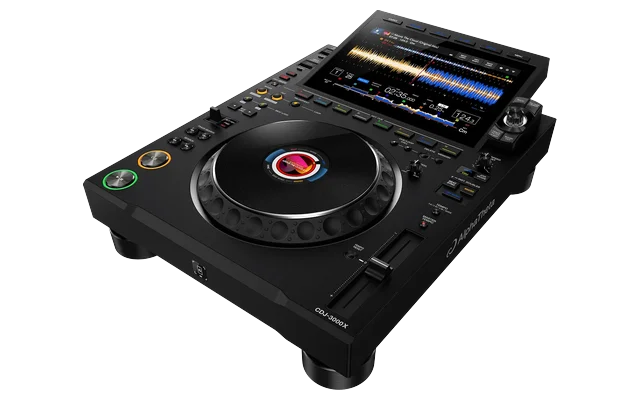
AlphaTheta CDJ-3000X
DJ media player, USB, MIDI, 10,1" touchscreen, LAN, Wi-Fi, NFC, Beatport, Tidal
13 000 HUF + VAT / unit / event

 01
01 02
02 03
03Dates and availability are confirmed by email. Rental terms
It is a large and heavy device, so typically the best place for the device is in the DJ counters of festivals and large arenas.
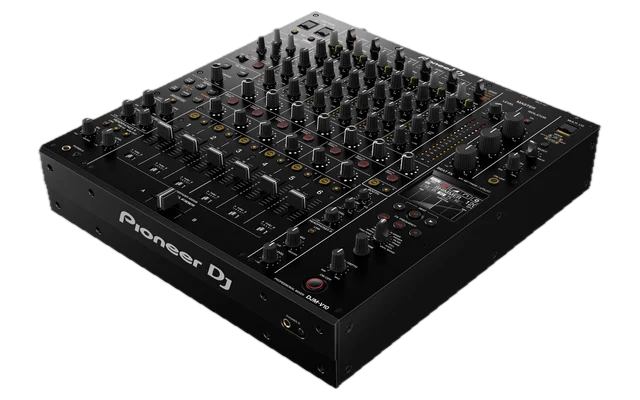
In my view, Pioneer wanted to make a current all-carrier mixer.
As a new member of the DJM-1000 >SVM-1000 >DJM-2000> DJM-2000NXS model series, it is the current most-leg-leg device.
Currently, there are three devices that can be said to be the standard of the international big club/festival:
-DJM-900NXS2
-Xone-96
-Model1
The Pioneer V10 mixer combines the properties of these three devices in one unit.
We have 6 bands and 4 tones per band.
The four tones per band were fashionable on Xone mixers (Xone-62, Xone-92, Xone-96), which is probably where Pioneer took over.
The 6 bands are mostly present on the Model1, although the DJM-1000 was also 6 channels a long time ago.
Both Xone-92 and 96 are actually 6-track channels with, say, 4 dj channels and 2 "orchestral" channels.
(At Xone, the two "orchestral" channels are good for both a microphone and an external effect).
We could also meet the two types of listening to the cue at the Model1 mixer, and this is also here.
To my great heartache, even with this large mixer, Pioneer could not put a proper microphone channel into it.
There are still only two tones, and they also control both microphone channels at the same time.
Of course, working on such a mixer is usually a DJ who does not speak into a microphone....
I haven't compared the sound of the mixers yet, but I'll do it soon, until then I can't say how it sounds.
The great strength of the Model1 and Xone-96 mixers is their excellent sound quality.
I think the illumination of the buttons is also negative.
On previous Pioneer machines, the CUE and Effect start buttons were fully lit, while on the V10 only a small contour of the buttons is lit.
At V10, the brightness of the buttons can be adjusted in 3 steps in the menu.
Due to the design of the buttons, even the highest brightness is not enough at a summer outdoor festival, and then due to the large surrounding brightness, it is not possible to see which button is active.
The display is bigger than the DJM-900NXS2 but it is so strange to see.
Somehow, the characters aren't the right ones.
The brightness of the display can be adjusted in five steps, but even the highest is not enough for outdoor parties.
The readability of the display is simply not good.
There is an option and it is possible to set the display to inverse, everything will be blindingly white.
Maybe this setting was meant for summer festival parties, let's see if it works.
In any case, the display is touch-sensitive and each tick can be adjusted.
There are a lot of menu items because besides the general settings of the mixer, the effects can also be parameterized.
Now, this will surely be claimed by a few people, such a fag was in the Xone DB-4 mixer.
The 3-track tone regulating the output Master channel is very good, this was already in the DJM-1000.
Finally, they put a equalizer on the monitor channel, albeit with only two bands and very small buttons.
It is very uncomfortable to twist the buttons of the monitor tone potik, they are so small.
In addition to the analogs, all six channels have a digital input and an AES/EBU digitlis exit.
Usually, only large festivals have a serious sound system whose mixer-processor accepts such a signal.
The sound system, which is free of analog conversions and operates with purely digital signal transmission, may sound better, but the question is whether someone will use this connection.
There is usually little time to switch at a festival, and on stage only analog group cables are pulled out between the instruments and the stage mixer.
I have both DJM-V10 and DJM-V10LF versions.
Otherwise, the whole mixer has the effect of 'putting everything we currently know and others know into it'
DJ media player, USB, MIDI, 10,1" touchscreen, LAN, Wi-Fi, NFC, Beatport, Tidal
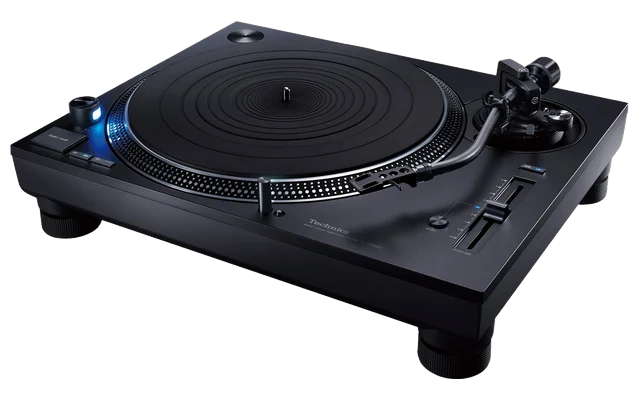
Stable rotation provided by a direct drive motor without iron coreIn 1970, Technics revolutionized the turntable industry with the world's first direct drive system. Unlike…
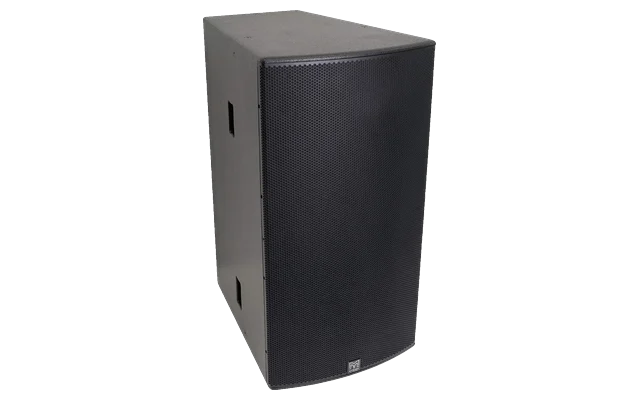
TYPE Three-way bi-amp trapezoid Hybrid® fully horn loaded FREQUENCY RESPONSE (5) 50Hz-18kHz ± 3dB…